Richard Strauss
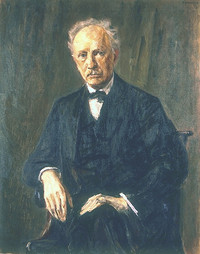
Richard Georg Strauss (German: [ˈʁɪçaʁt ˈʃtʁaʊs]; 11 June 1864 – 8 September 1949) was a German composer and conductor best known for his tone poems and operas. Considered a leading composer of the late Romantic and early modern eras, he has been described as a successor of Richard Wagner and Franz Liszt. Along with Gustav Mahler, he represents the late flowering of German Romanticism, in which pioneering subtleties of orchestration are combined with an advanced harmonic style.
Strauss's compositional output began in 1870 when he was just six years old and lasted until his death nearly eighty years later. His first tone poem to achieve wide acclaim was Don Juan, and this was followed by other lauded works of this kind, including Death and Transfiguration, Till Eulenspiegel's Merry Pranks, Also sprach Zarathustra, Don Quixote, Ein Heldenleben, Symphonia Domestica, and An Alpine Symphony. His first opera to achieve international fame was Salome, which used a libretto by Hedwig Lachmann that was a German translation of the French play Salomé by Oscar Wilde. This was followed by several critically acclaimed operas with librettist Hugo von Hofmannsthal: Elektra, Der Rosenkavalier, Ariadne auf Naxos, Die Frau ohne Schatten, Die ägyptische Helena, and Arabella. His last operas, Daphne, Friedenstag, Die Liebe der Danae and Capriccio used libretti written by Joseph Gregor, the Viennese theatre historian. Other well-known works by Strauss include two symphonies, lieder (especially the Four Last Songs), the Violin Concerto in D minor, the Horn Concerto No. 1, Horn Concerto No. 2, his Oboe Concerto and other instrumental works such as Metamorphosen.
A prominent conductor in Western Europe and the Americas, Strauss enjoyed quasi-celebrity status as his compositions became standards of orchestral and operatic repertoire. He was chiefly admired for his interpretations of the works of Liszt, Mozart, and Wagner in addition to his own works. A conducting disciple of Hans von Bülow, Strauss began his conducting career as Bülow's assistant with the Meiningen Court Orchestra in 1883. After Bülow resigned in 1885, Strauss served as that orchestra's primary conductor for five months before being appointed to the conducting staff of the Bavarian State Opera where he worked as third conductor from 1886 to 1889. He then served as principal conductor of the Deutsches Nationaltheater und Staatskapelle Weimar from 1889 to 1894. In 1894 he made his conducting debut at the Bayreuth Festival, conducting Wagner's Tannhäuser with his wife, soprano Pauline de Ahna, singing Elisabeth. He then returned to the Bavarian State Opera, this time as principal conductor, from 1894 to 1898, after which he was principal conductor of the Berlin State Opera from 1898 to 1913. From 1919 to 1924 he was principal conductor of the Vienna State Opera, and in 1920 he co-founded the Salzburg Festival. In addition to these posts, Strauss was a frequent guest conductor in opera houses and with orchestras internationally.
In 1933 Strauss was appointed to two important positions in the musical life of Nazi Germany: head of the Reichsmusikkammer and principal conductor of the Bayreuth Festival. The latter role he accepted after conductor Arturo Toscanini had resigned from the position in protest against the Nazi Party. These positions have led some to criticize Strauss for his seeming collaboration with the Nazis. However, Strauss's daughter-in-law, Alice Grab Strauss [née von Hermannswörth], was Jewish and much of his apparent acquiescence to the Nazi Party was done to save her life and the lives of her children (his Jewish grandchildren). He was also apolitical, and took the Reichsmusikkammer post to advance copyright protections for composers, attempting as well to preserve performances of works by banned composers such as Mahler and Felix Mendelssohn. Further, Strauss insisted on using a Jewish librettist, Stefan Zweig, for his opera Die schweigsame Frau which ultimately led to his firing from the Reichsmusikkammer and Bayreuth. His opera Friedenstag, which premiered just before the outbreak of World War II, was a thinly veiled criticism of the Nazi Party that attempted to persuade Germans to abandon violence for peace. Thanks to his influence, his daughter-in-law was placed under protected house arrest during the war, but despite extensive efforts he was unable to save dozens of his in-laws from being killed in Nazi concentration camps. In 1948, a year before his death, he was cleared of any wrongdoing by a denazification tribunal in Munich.
-
Mozart: Requiem in D Minor, K. 626: VIII. Lacrimosa - Peaceful Rest (Forever) -
Richard Strauss
-
Fauré: Requiem, Op. 48: VII. In Paradisum - Peaceful Rest (Forever) -
Richard Strauss
-
Purcell: Funeral Sentences: Thou Know'st, Lord, Z. 58C (First Verse) - Peaceful Rest (Forever) -
Richard Strauss
-
Duruflé: Requiem, Op. 9: VIII. Lux æterna - Peaceful Rest (Forever) -
Richard Strauss
-
Schubert: String Quartet No. 14 in D Minor, D. 810 "Death and the Maiden": II. (b) Variation I - Peaceful Rest (Forever) -
Richard Strauss
-
Vaughan Williams: O Taste and See - Peaceful Rest (Forever) -
Richard Strauss
-
Walton: Henry V: Passacaglia "Death of Falstaff" - Peaceful Rest (Forever) -
Richard Strauss
-
Campra: Messe de requiem: VI. Agnus Dei - Peaceful Rest (Forever) -
Richard Strauss
-
Schuman: Carols of Death: No. 3, To All, to Each - Peaceful Rest (Forever) -
Richard Strauss
-
Debussy: 6 Épigraphes antiques, CD 139b, L. 131: No. 2, Pour un tombeau sans nom - Peaceful Rest (Forever) -
Richard Strauss
-
Ockeghem: Missa pro defunctis: I. Requiem aeternam - Peaceful Rest (Forever) -
Richard Strauss
-
Biber: Requiem a 15 in A Major: VI. Agnus Dei - Peaceful Rest (Forever) -
Richard Strauss
-
Beethoven: Piano Sonata No. 12 in A-Flat Major, Op. 26: III. Marcia funebre sulla morte d'un eroe. Maestoso andante - Peaceful Rest (Forever) -
Richard Strauss
-
Vivaldi: Concerto funebre in B-Flat Major, RV 579: I. Largo - Peaceful Rest (Forever) -
Richard Strauss
-
Philidor: Marche des pompes funèbres pour les grandes cérémonies - Peaceful Rest (Forever) -
Richard Strauss
-
Grieg: Peer Gynt, Op. 23, Act 3: No. 12, The Death of Åse - Peaceful Rest (Forever) -
Richard Strauss
-
Gilles: Requiem: VII. Offertorium - Peaceful Rest (Forever) -
Richard Strauss
-
Elgar: The Dream of Gerontius, Op. 38, Pt. 2: Andantino - Peaceful Rest (Forever) -
Richard Strauss
-
Berlioz: La Mort d'Orphée, H. 25: V. Tableau musical - Peaceful Rest (Forever) -
Richard Strauss
-
Verdelot: Il primo libro de madrigali: No. 15, Si liet'e grata morte - Peaceful Rest (Forever) -
Richard Strauss
-
Schumann: Requiem, Op. 148: I. Requiem aeternam - Peaceful Rest (Forever) -
Richard Strauss
-
Ravel: 2 Mélodies hébraïques, M. A 22: No. 1, Kaddish (Transcr. Siloti for Piano) - Peaceful Rest (Forever) -
Richard Strauss
-
Strauss, R: Don Quixote, Op. 35: Finale. Death of Don Quixote - Peaceful Rest (Forever) -
Richard Strauss
-
Des Prez: La déploration de Jehan Ockeghem "Nymphes des bois / Requiem" - Peaceful Rest (Forever) -
Richard Strauss
-
Mendelssohn: String Quartet No. 6 in F Minor, Op. 80, MWV R37: III. Adagio - Peaceful Rest (Forever) -
Richard Strauss
-
Chopin: Piano Sonata No. 2 in B-Flat Minor, Op. 35 "Funeral March": III. Marche funèbre. Lento - Peaceful Rest (Forever) -
Richard Strauss
-
Rachmaninov: Vespers, Op. 37: IV. Svete tikhiy - Peaceful Rest (Forever) -
Richard Strauss
-
Dvořák: Requiem, Op. 89, B. 165: XII. Pie Jesu - Peaceful Rest (Forever) -
Richard Strauss
-
Couperin, L: Tombeau de Monsieur de Blancrocher - Peaceful Rest (Forever) -
Richard Strauss
-
Froberger: Partita in C Major, FbWV 612: I. Lamento sopra la perdita di Ferdinando IV - Peaceful Rest (Forever) -
Richard Strauss
-
Gounod: Mors et vita, Pt. 1 "Mors": Requiem. "Agnus Dei" - Peaceful Rest (Forever) -
Richard Strauss
-
Tchaikovsky: String Quartet No. 3 in E-Flat Minor, Op. 30: III. Andante funebre e doloroso, ma con moto - Peaceful Rest (Forever) -
Richard Strauss
-
Eine Alpensinfonie, Op. 64, TrV 233: I. Nacht - Strauss: Eine Alpensinfonie -
Richard Strauss
-
Eine Alpensinfonie, Op. 64, TrV 233: II. Sonnenaufgang - Strauss: Eine Alpensinfonie -
Richard Strauss
-
Eine Alpensinfonie, Op. 64, TrV 233: III. Der Anstieg - Strauss: Eine Alpensinfonie -
Richard Strauss
-
Eine Alpensinfonie, Op. 64, TrV 233: IV. Eintritt in den Wald - Strauss: Eine Alpensinfonie -
Richard Strauss
-
Eine Alpensinfonie, Op. 64, TrV 233: VIII. Auf blumigen Wiesen - Strauss: Eine Alpensinfonie -
Richard Strauss
-
Eine Alpensinfonie, Op. 64, TrV 233: IX. Auf der Alm - Strauss: Eine Alpensinfonie -
Richard Strauss
-
Eine Alpensinfonie, Op. 64, TrV 233: XI. Auf dem Gletscher - Strauss: Eine Alpensinfonie -
Richard Strauss
-
Eine Alpensinfonie, Op. 64, TrV 233: XVII. Elegie - Strauss: Eine Alpensinfonie -
Richard Strauss
-
Eine Alpensinfonie, Op. 64, TrV 233: XXII. Nacht - Strauss: Eine Alpensinfonie -
Richard Strauss
-
Also sprach Zarathustra, Op. 30, TrV 176: Einleitung - Music (Remastered 2015) -
Richard Strauss
-
Also sprach Zarathustra, Op. 30, TrV 176: Von den Hinterweltlern - Music (Remastered 2015) -
Richard Strauss
-
Also sprach Zarathustra, Op. 30, TrV 176: Von der großen Sehnsucht - Music (Remastered 2015) -
Richard Strauss
-
Also sprach Zarathustra, Op. 30, TrV 176: Von den Freuden und Leidenschaften - Music (Remastered 2015) -
Richard Strauss
-
Also sprach Zarathustra, Op. 30, TrV 176: Das Grablied - Music (Remastered 2015) -
Richard Strauss
-
Also sprach Zarathustra, Op. 30, TrV 176: Von der Wissenschaft - Music (Remastered 2015) -
Richard Strauss
-
Also sprach Zarathustra, Op. 30, TrV 176: Der Genesende (Beginning) - Music (Remastered 2015) -
Richard Strauss
-
Also sprach Zarathustra, Op. 30, TrV 176: Der Genesende (Conclusion) - Music (Remastered 2015) -
Richard Strauss
-
Also sprach Zarathustra, Op. 30, TrV 176: Das Tanzlied - Music (Remastered 2015) -
Richard Strauss
-
Also sprach Zarathustra, Op. 30, TrV 176: Nachtwandlerlied - Music (Remastered 2015) -
Richard Strauss
-
Die schweigsame Frau, Op. 80, TrV 265: Euer Liebden haben, ich fürchte, schlecht geschlafen - R. Strauss: Die schweigsame Frau, Op. 80, TrV 265 -
Richard Strauss
-
Die schweigsame Frau, Op. 80, TrV 265: Piano, piano! Und ich sage euch, er ist ein kreuzbraver Kerl - R. Strauss: Die schweigsame Frau, Op. 80, TrV 265 -
Richard Strauss
-
Die schweigsame Frau, Op. 80, TrV 265: Hah! Mir fällt etwas ein! - R. Strauss: Die schweigsame Frau, Op. 80, TrV 265 -
Richard Strauss
-
Die schweigsame Frau, Op. 80, TrV 265: Nicht viel schwätzen, nicht parlieren - R. Strauss: Die schweigsame Frau, Op. 80, TrV 265 -
Richard Strauss
-
Die schweigsame Frau, Op. 80, TrV 265: Anhiero gestatte ich mir, hochverehrliche Herren - R. Strauss: Die schweigsame Frau, Op. 80, TrV 265 -
Richard Strauss
-
Die schweigsame Frau, Op. 80, TrV 265: Du bist so still - R. Strauss: Die schweigsame Frau, Op. 80, TrV 265 -
Richard Strauss
-
Die schweigsame Frau, Op. 80, TrV 265: Was geht hier vor? - R. Strauss: Die schweigsame Frau, Op. 80, TrV 265 -
Richard Strauss
-
Die schweigsame Frau, Op. 80, TrV 265: Siehst du, Ohm - R. Strauss: Die schweigsame Frau, Op. 80, TrV 265 -
Richard Strauss
-
Die schweigsame Frau, Op. 80, TrV 265: Du süßester Engel - R. Strauss: Die schweigsame Frau, Op. 80, TrV 265 -
Richard Strauss
Similar Artists